
ZoA – Zone of acceptance
Tanzschreiber
Interspecies and ZoA research in
Relational ImprovisationMusic, Dance and Contemporary Art Book by Simon Rose
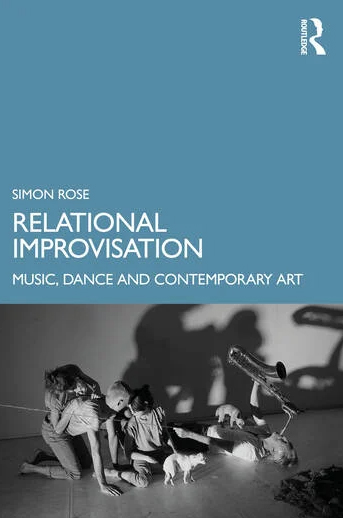
Photo cover: Lilli Capuccina, Claudia Tomasi, Simon Rose, Chichina, Rudi Pistacchi, Aimee, Paolo Rosini & Barbara Berti. Photo by Dieter Hartwig
DOGOD
Antinome magazine
Il fattoquotidiano newspaper
Tanzschreiber
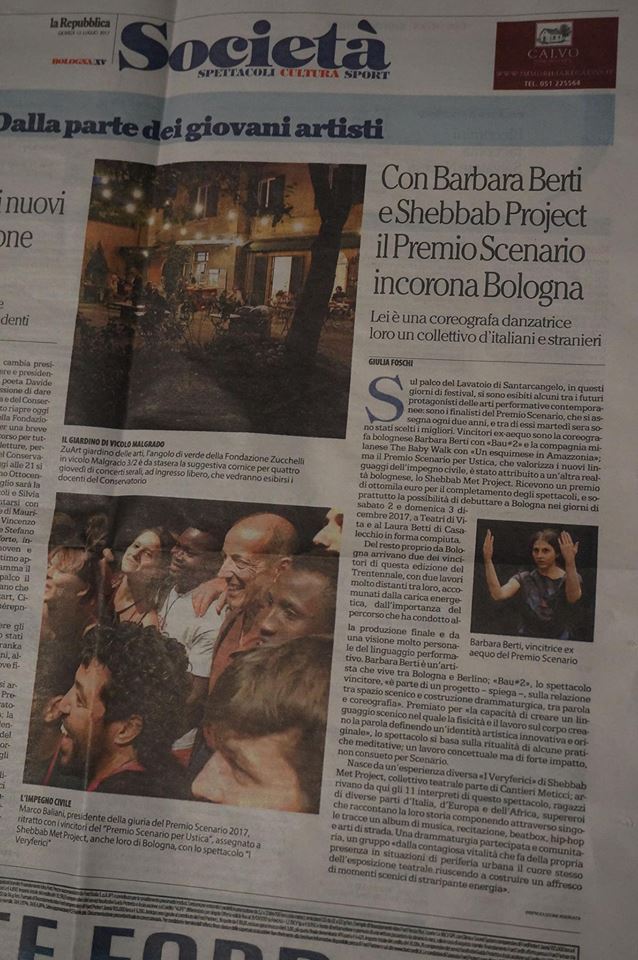
BAU #2
From the series BAU – Choreography of thinking
Winner Award Premio Scenario in 2017
Paperstreet.it
casicritici.com
Cuture teatrali
Gagarin-magazine.it
Altrevelocita.it
Da Torino lo sguardo alternativo alle Live Arts
Strategies
Passages Bauhaus – City of Dessau
Installations in the public domain.
at the Dessau Foundation Bauhaus
tv HERE
BAU#1
Tanzschreiber
Teatro Critica
DOPPIO ZERO
CATALOG NATIONAL GALLERY OF ROME
I am a shape, in a shape, doing a shape
Winner 100Grad Prize in 2014
HTTPS://100GRAD.WORDPRESS.COM/2015/03/02/INTERACTION-WITH-ALL-SENSES
ACTING THINGS IV
The Choreography of Collaboration
DOGOD. The situation
Santarcangelo festival 2021
(Premier Acud Berlin 2020)
Il fattoquotidiano newspaper
Barbara Berti’s dogs on stage to break down the boundaries of species
by Davide Turrini
It’s called Dogod – The situation and it was one of the most interesting performances of the section Bestiari Fantastici in the last edition of the historic theater festival in Romagna, more and more hybridized between different performing arts.
If you have food in your bags please leave them at the entrance”. Dogod – The situation, the body mind centering performance by Barbara Berti, premiered at the last Sant’Arcangelo Festival 2021, has a fundamental and prosaic premise. Because on stage, besides Berti herself, Marco Mazzoni and Rocio Marano, there are three little dogs: Rudi-Pistachio, Boki and Marzia. A Chihuahua, a poodle with a rainbow tail and a French bulldog. No spectacular Corrida (television), but an exclamatory, sinuous, hypnotic stage ritual where the bodies of the actors merge and no longer distinguish between human and animal. The cultural and social boundary between the species immediately ends up in the inclusive space of a square scene, with a central floor and all around the spectators arranged equally without chairs or steps. As the authors write in the description of the work: “The ideas of fun, play and struggle induce the participants to navigate in instantaneous and interactive choreographic flows”.
Berti, Mazzoni and Marano immediately inhabit the space trying to map it silently and sensorially in the movement and gestures of a practice that recalls the suppleness of many yoga positions as a sort of reacquisition of an emptiness through the fullness of one’s own body. An (in)visible widening and a perceptive fading at the same time that introduce the gradual entry on the scene, one by one, at a distance of a few minutes, of the three little dogs. Animals that, especially for the Chihuahua, blatantly merge into a whole of flesh and spirit, clinging with strength and thought to Mazzoni’s shoulders, for example, then slowly passed with their arms over the bellies, backs and legs of Berti and Marano. And while Mazzoni continually props up the ceiling with fake extendable poles, often asking (without speaking) the spectator to extract pieces of them together with him, the bulldog and the poodle reiterate the olfactory discovery by continually approaching the spectators around them. The movement, however, leads to a stasis, almost central to Dogod’s 35 minutes, where men and animals lie on the ground motionless, silent, curled up, organic to each other.
Then it is the canine barking, controlled, requested, rehearsed, to awaken the senses and the sense of the transformative, metamorphic, living embrace, where, as the American philosopher Donna Haraway argues, quoted by Berti in the director’s notes, we rethink “being able to join another, to see together without pretending to be another”. We leave Dogod, a palindrome that mixes canine presence and theological absence/presence, with the idea that an artistic boundary has been crossed and ethically we cannot and must not go back. For the record: at the end of the show Rudi-Pistacchio, Boki and Marzia don’t really want to entertain themselves with the spectators who are looking for a caress or closeness. And this too, it is evident, is part of the ongoing transition of the felling of species conveyed on stage.
Santarcangelo 2021, i cani di Barbara Berti in scena per abbattere i confini di specie
di Davide Turrini
S’intitola Dogod – The situation ed è stata una delle performance più interessanti della sezione Bestiari Fantastici nell’ultima edizione dello storico festival teatrale romagnolo sempre più ibridato tra differenti arti performative.
Se avete del cibo nelle vostre borse siete pregati di lasciarle all’ingresso”. Dogod – The situation, la performance body mind centering di Barbara Berti, in anteprima all’ultimo Festival di Sant’Arcangelo 2021, ha una fondamentale e prosaica premessa. Perché in scena, oltre alla Berti stessa, a Marco Mazzoni e Rocio Marano, ci sono tre cagnetti: Rudi-Pistacchio, Boki e Marzia. Un chihuaua, un barboncino con una coda arcobaleno e una bulldog francese. Niente spettacolarizzante Corrida (televisiva), ma un esclamativo, sinuoso, ipnotico rituale di scena dove i corpi degli attori si fondono e non si distinguono più tra quelli umani e animali. Il confine culturale e sociale tra le specie finisce immediatamente dentro allo spazio inclusivo di una scena quadrata, pavimento centrale con tutt’attorno disposti paritari senza seggiole o gradini gli spettatori. Come scrivono gli autori nella descrizione del lavoro: “Le idee di divertimento, gioco e lotta inducono i partecipanti a navigare in flussi coreografici istantanei e interattivi”.
Berti, Mazzoni e Marano abitano subito lo spazio cercando di mapparlo silenziosamente e sensorialmente nel movimento e nella gestualità di una pratica che ricorda le flessuosità di molte posizioni yoga come una sorta di riacquisizione di un vuoto attraverso il pieno del proprio corpo. Un allargamento (in)visibile e uno dissolvimento percettivo allo stesso tempo che introducono l’entrata in scena graduale, uno per volta, a distanza di qualche minuto, dei tre cagnetti. Animali che, soprattutto per il chihuaua, si fondono platealmente in un tutt’uno di carne e spirito, aggrappati con forza e pensiero alle spalle di Mazzoni, ad esempio, poi lentamente passati di braccia su ventre, schiena e gambe di Berti e Marano. E mentre Mazzoni puntella continuamente il soffitto con finte pertiche allungabili, chiedendo (senza parlare) spesso allo spettatore di estrarne pezzi assieme a lui, la bulldoghina e il barboncino reiterano la scoperta olfattiva avvicinandosi di continuo agli spettatori attorno. Il movimento però porta ad una stasi, quasi centrale nei 35 minuti di Dogod, dove uomini e animali giacciono a terra immobili, silenti, accartocciati, organici l’uno all’altro.
Poi è l’abbaiare canino, controllato, richiesto, provato, a ridestare i sensi e il senso dell’abbraccio trasformativo, metamorfico, vivente, dove, come sostiene la filosofa statunitense Donna Haraway, citata dalla Berti nelle note di regia si ripensa “l’essere in grado di unirsi a un altro, di vedere insieme senza fingere di essere un altro”. Si esce da Dogod, un palindromo che mescola presenza canina e assenza/presenza teologica, con l’idea che un confine artistico è stato superato e indietro eticamente non si può e non si deve tornare. Per la cronaca: a fine spettacolo Rudi-Pistacchio, Boki e Marzia non hanno realmente una gran voglia di intrattenersi con gli spettatori che cercano la carezza o la vicinanza. E anche questo, è evidente, fa parte della transizione in essere dell’abbattimento di specie veicolata in scena.
DOGOD. The situation
Submerge festival 2021
Tanzschreiber
Who let the dogs out?
August 8, 2021, by Jenny Mahla
Barbara Berti leaves us with “DOGOD. The Situation ”at the end of the five-week SUBMERGE Festival 2021 in the Lake Studios Berlin to participate in their performative work with dogs and we are all ears.
In the course of the almost one-hour piece, the three performers (Rocio Marano, Marco Mazzoni and Barbara Berti) recited text pieces and breath noises, and the Chihuahuas’ little tippy steps when they walk across the wooden floor of the dance studio and curiously at it can be heard over and over again sniff the shoes of the spectators. “DOGOD. The Situation “works completely without music and creates a mindful atmosphere of focused togetherness, which allows people, animals and space to come into contact.
The slow movements of the performers are coordinated and you can see that the empathic interaction with the four-legged friends is based on trust. Barbara Berti cast the three animal actors (Rudi Pistacchio, Boki and Lilli) because she doesn’t have a dog herself. However, she has a special knack for dogs and so the two Chihuahuas and the poodle are in a kind of therapeutic treatment with her during the rehearsal phase. Physical trauma can also be experienced by small dogs, as she reports in the conversation. With appropriate massages and a lot of attention, she not only builds an emotional connection with you, but also supports you to feel physically comfortable and safe in general. How relaxed the dogs are in the piece,
Her good-natured and confident ride on the dancing bodies brings a new perspective into play. If dance means the relationship between bodies and space, we are first faced with the unfamiliar situation of having to classify a small four-legged animal body into this system of relationships. This is exactly what opens up an exciting field, because the careful movements of two performers are no longer a duet but a trio when a dog balances between the neck and shoulder blades. The human bodies are determined and guided in their movement exploration by these very animal beings. We see dance sequences without a dog, at least this evening, differently. In this way, Barbara Berti has expanded the relationship to space, which is tirelessly explored in contemporary dance, to include a cross-species dimension.
It is also exciting to observe the animals themselves in their observation of the performative events. It is not just the cognitive focus, but an attention of the whole body that you give to the respective situation. That this is inspiring for artistic processes that put the body at the center of interest is therefore more obvious than we might have initially thought.
The Italian artist, who lives in Berlin, sees her work as a performative practice and it becomes quite evident that her choreographies are influenced, among other things, by contact improvisation, somatics and a curiosity for a deeper understanding of relationships. For the evening at Lake Studios, she and her human performers Rocio Marano and Paolo Rosini designed a clear choreographic structure. As the title suggests, including the word play of Dog and God, we as viewers playfully experience different situations and, above all, poses of the different bodies, which freely explore spatial coexistence.
In the announcement text, Berti writes that for her, physicality is a means of spatial communication and thus an expression of one’s own territory instead of identity. She links this understanding with Donna Haraway’s suggestion to rethink the relationships between species. Reflections on how we see each other and how we influence each other are certainly colored fundamentally different in connection with the four-legged friends. Because the projection of one’s own self onto a dog is much less pronounced and so the animal counterpart makes us aware of a different point of view above all if we take it seriously as part of the whole and let us get involved with its perspective. For the artists, their own identity as a person may then move a little into the background, when the different forms of movement as well as the lifeworlds of humans and animals come into contact without becoming one. It is precisely this theoretical and cross-species socio-philosophical background that makes Barbara Berti’s work exciting and we should keep our eyes and ears open for further thoughts and works by the artist, hopefully fed by Donna Haraway.
Die Intimität zwischen Zuschauenden und Performenden ist wahrscheinlich ein Grundbaustein im zeitgenössischen Tanz. Menschen, die sich auf einer Bühne bewegen, treten – gerade wenn das Bewegungsmaterial keine klassischen Formensprachen bedient, gewöhnlich in einem semantischen Raum ein, der immer mit einem Rest nicht zu entzifferbaren Potenzial gefüllt ist. Barbara Berti formuliert mit ihrer choreografischen Reihe „BAU – A choreography of thinking“ das Interesse, sog. „instinktiven“ Momenten menschlichen Denkens nachzuspüren. Die „bewusste“ Wahrnehmungsebene der Wirklichkeit soll gemeinsam zwischen Zuschauenden und Performerin überprüft, neuangeordnet, choreografiert werden.
Soviel zum konzeptuellen Über-BAU. Wirklich eingelöst wird dieses nach Experiment darbende Konzept im Laufe der ersten Performance „#213 BAU 1 – An interactive piece“ jedoch nur bedingt. Oder vielleicht insofern als dass jede performative Handlung und jede Begegnung zwischen Körpern immer auch von Momenten der Imagination, des (Un-)Bewusstseins/Unbewusstseins durchzogen ist. Was also macht die BAU- Reihe zu einem besonderen Umgang mit dieser Ausgangslage?
Eine Spur liegt sicher in der Erscheinung von Barbara Berti als Performerin. Sie tritt auch hier mit gewohnt minimalistischen Mitteln, in einem intimen Setting auf: ein leerer Bühnenraum, von einem schwarzen Vorhang begrenzt, der nach sich hinten zu einem Spalt hin öffnet und dem Raum dort eine Tiefe verleiht, Barbara Berti selbst – in ockerfarbener Kleidung, fast unscheinbar, auf jeden Fall in gewohnt betonter Gelassenheit. Ruhigen Schrittes durchmisst sie Bühne. Ihr Blick Richtung Publikum ist ein abwesend-suchender. Halb geöffneter Mund und in die Ferne (oder in ein Inneres?) schweifende Augen verraten, dass es um abwesende Prozesse der Wahrnehmung gehen soll. Die Resonanz zwischen ihr und dem Publikum lenkt scheinbar Richtung und Intensität ihrer Bewegungen. Oder veranlasst mich nur das Programmheft zu dieser These? Alles an diesem Tempo, an diesen Bewegungen und Schrittfolgen so ausgeglichen, so von Unaufgeregtheit durchzogen, wie man es auch von zeitgenössischen, von BMC und somatischen Praktiken informierten Performances nur allzu gut gewohnt sind.
Okay, mal angenommen, sie ist dabei, etwas nachzuspüren… Innehalten, Einatmen, Ausatmen. Können wir den Moment ausmachen, der sie zum Bellen veranlasst hat? Denn das ist die beste Szene des ganzen Abends: Barbara Berti steht in einiger Nähe zum Publikum, starren Blickes, scheint in eine andere Dimension zu versinken, ihre Lippen beginnen, sich langsam nach oben zu schieben, die Zähne kommen zum Vorschein… eine leichte Beugung des Oberkörpers setzt ein, das Zwerchfell zieht sich zusammen, Schultern zucken, Arme hängen schlaff herab: …“Wwwwwuff. Wwwwwwuuuuufff.“
Dieser Moment, in dem überraschend ein Bellen und Knurren aus der Performerin herauszubrechen droht, ist einer, der wirklich so etwas wie einen imaginativen Raum aufmacht.
Wenn sie daran anschließend beginnt, ihre weitere Impro/Choreografie mit Sätzen und Versatzstücken zu unterlegen, die sich direkt und indirekt an die Wahrnehmung der Zuschauer*innen richtet und diese zu lenken versucht: „what do you see?…Let it go…Don’t think too much“, führt das allerdings weniger zum intendierten „meditativen“ Zustand, sondern eher dazu, diese Lesart allzu stark zu forcieren. Soll die Wahrnehmung dadurch verkompliziert werden, so gerät der konzeptuelle Über-BAU genau an der Stelle ins Wanken, an dem er allzu didaktisch eingefordert wird.
BAU#1 An interactive piece
Ballhaus ost Berlin 2018
Tanzschreiber
Bau Bau Über-Bau
Barbara Berti konstruiert im Ballhaus Ost mit ziemlich viel Minimalismus und hohem konzeptuellen Anspruch ein Gedankengerüst, das auf wackligen Füßen steht.
The intimacy between spectators and performers is probably a basic building block in contemporary dance. People who move on a stage usually enter a semantic space that is always filled with a remnant, indecipherable potential, especially if the movement material does not use classical formal languages. With her choreographic series “BAU – A choreography of thinking”, Barbara Berti formulates the interest in tracing so-called “instinctive” moments of human thought. The “conscious” level of perception of reality should be checked, rearranged and choreographed jointly between the viewer and the performer.
So much for the conceptual Über-BAU. This concept, which is starving after experimentation, is really only redeemed to a limited extent in the course of the first performance “BAU#1 – An interactive piece”. Or perhaps to the extent that every performative act and every encounter between bodies is always pervaded by moments of imagination, of (un) consciousness / unconsciousness. So what makes the BAU series special in dealing with this initial situation?
There is certainly a trace in the appearance of Barbara Berti as a performer. Here, too, she appears with the usual minimalist means, in an intimate setting: an empty stage space, bordered by a black curtain that opens to a gap at the back and gives the room a depth there, Barbara Berti herself – in ocher clothes, almost inconspicuous, in any case with the usual stressed serenity. She crosses the stage with a calm step. Your gaze towards the audience is absent-seeking. Half-open mouth and eyes wandering into the distance (or into something inside?) Reveal that it is about absent processes of perception. The resonance between her and the audience seems to guide the direction and intensity of her movements. Or is it only the program that prompts me to make this thesis? Everything about this pace, these movements and sequences of steps so balanced, so pervaded by calmness, as one is all too well used to from contemporary performances informed by BMC and somatic practices.
Okay, let’s say she’s trying to sense something … pause, inhale, exhale. Can we spot the moment that made her bark? Because that is the best scene of the whole evening: Barbara Berti stands close to the audience, staring, seems to sink into another dimension, her lips slowly begin to slide upwards, her teeth come out… a slight flexion of the upper body begins, the diaphragm contracts, shoulders shrug, arms hang limply:… “Wwwwwuff. Wwwwwwuuuuufff. “
This moment, when the performer suddenly threatens to bark and growl, is one that really opens up something like an imaginative space.
When she then begins to underlay her further impro / choreography with sentences and set pieces, which are aimed directly and indirectly at the perception of the audience and tries to steer them: “what do you see? … Let it go … Don ‘” t think too much ”, this leads less to the intended“ meditative ”state, but rather to force this reading too much. If this is to make perception more complicated, the conceptual over-building starts to falter precisely at the point where it is all too didactically demanded.
Barbara Berti konstruiert im Ballhaus Ost mit ziemlich viel Minimalismus und hohem konzeptuellen Anspruch ein Gedankengerüst, das auf wackligen Füßen steht.
Die Intimität zwischen Zuschauenden und Performenden ist wahrscheinlich ein Grundbaustein im zeitgenössischen Tanz. Menschen, die sich auf einer Bühne bewegen, treten – gerade wenn das Bewegungsmaterial keine klassischen Formensprachen bedient, gewöhnlich in einem semantischen Raum ein, der immer mit einem Rest nicht zu entzifferbaren Potenzial gefüllt ist. Barbara Berti formuliert mit ihrer choreografischen Reihe „BAU – A choreography of thinking“ das Interesse, sog. „instinktiven“ Momenten menschlichen Denkens nachzuspüren. Die „bewusste“ Wahrnehmungsebene der Wirklichkeit soll gemeinsam zwischen Zuschauenden und Performerin überprüft, neuangeordnet, choreografiert werden.
Soviel zum konzeptuellen Über-BAU. Wirklich eingelöst wird dieses nach Experiment darbende Konzept im Laufe der ersten Performance „#213 BAU 1 – An interactive piece“ jedoch nur bedingt. Oder vielleicht insofern als dass jede performative Handlung und jede Begegnung zwischen Körpern immer auch von Momenten der Imagination, des (Un-)Bewusstseins/Unbewusstseins durchzogen ist. Was also macht die BAU- Reihe zu einem besonderen Umgang mit dieser Ausgangslage?
Eine Spur liegt sicher in der Erscheinung von Barbara Berti als Performerin. Sie tritt auch hier mit gewohnt minimalistischen Mitteln, in einem intimen Setting auf: ein leerer Bühnenraum, von einem schwarzen Vorhang begrenzt, der nach sich hinten zu einem Spalt hin öffnet und dem Raum dort eine Tiefe verleiht, Barbara Berti selbst – in ockerfarbener Kleidung, fast unscheinbar, auf jeden Fall in gewohnt betonter Gelassenheit. Ruhigen Schrittes durchmisst sie Bühne. Ihr Blick Richtung Publikum ist ein abwesend-suchender. Halb geöffneter Mund und in die Ferne (oder in ein Inneres?) schweifende Augen verraten, dass es um abwesende Prozesse der Wahrnehmung gehen soll. Die Resonanz zwischen ihr und dem Publikum lenkt scheinbar Richtung und Intensität ihrer Bewegungen. Oder veranlasst mich nur das Programmheft zu dieser These? Alles an diesem Tempo, an diesen Bewegungen und Schrittfolgen so ausgeglichen, so von Unaufgeregtheit durchzogen, wie man es auch von zeitgenössischen, von BMC und somatischen Praktiken informierten Performances nur allzu gut gewohnt sind.
Okay, mal angenommen, sie ist dabei, etwas nachzuspüren… Innehalten, Einatmen, Ausatmen. Können wir den Moment ausmachen, der sie zum Bellen veranlasst hat? Denn das ist die beste Szene des ganzen Abends: Barbara Berti steht in einiger Nähe zum Publikum, starren Blickes, scheint in eine andere Dimension zu versinken, ihre Lippen beginnen, sich langsam nach oben zu schieben, die Zähne kommen zum Vorschein… eine leichte Beugung des Oberkörpers setzt ein, das Zwerchfell zieht sich zusammen, Schultern zucken, Arme hängen schlaff herab: …“Wwwwwuff. Wwwwwwuuuuufff.“
Dieser Moment, in dem überraschend ein Bellen und Knurren aus der Performerin herauszubrechen droht, ist einer, der wirklich so etwas wie einen imaginativen Raum aufmacht.
Wenn sie daran anschließend beginnt, ihre weitere Impro/Choreografie mit Sätzen und Versatzstücken zu unterlegen, die sich direkt und indirekt an die Wahrnehmung der Zuschauer*innen richtet und diese zu lenken versucht: „what do you see?…Let it go…Don’t think too much“, führt das allerdings weniger zum intendierten „meditativen“ Zustand, sondern eher dazu, diese Lesart allzu stark zu forcieren. Soll die Wahrnehmung dadurch verkompliziert werden, so gerät der konzeptuelle Über-BAU genau an der Stelle ins Wanken, an dem er allzu didaktisch eingefordert wird.
BAU #2
From the serie BAU – Choreography of thinking
Winner Award Premio Scenario in 2017
Paperstreet.it
of Giulio Sonno
There is the “alien” case of Barbara Berti. Happily alien, we would say. It is alien because the Bolognese choreographer proves to be totally distant from all this broth called ‘Contemporaneity’, and if she too, in some way, touches on the question of identity with irony, she does it in such a radical way as to completely clear the cards. What does it mean? Berti does not resort to any easy support of the collective imagination, on the contrary, he defies any assertiveness, presenting work that hardly finds a place between dance, theater or – the always comfortable binder – performance.
BAU #2, in fact, is a work focused on waste, a gap that does not have a Western matrix, that is, it is not denied itself, for then to refers to something else, it is an absolute self-irony, completely distant from the temptation of analogy.
That Berti has won Scenario is perhaps one of the most encouraging signs of recent times. And surely the Bolognese artist (resident not by chance in Berlin) will not have an easy life in the Italian scene. But it remains an important sign.
C’è il caso «alieno» di Barbara Berti. Felicemente alieno, diremmo. È alieno perché la coreografa bolognese si dimostra totalmente distante da tutto questo brodo chiamato contemporaneità, e se anche lei, in qualche modo, va a toccare la questione dell’identità con ironia, lo fa in una maniera talmente radicale da sparigliare completamente le carte. Cosa vuol dire? Berti non fa ricorso ad alcun facile sostegno dell’immaginario collettivo, anzi, diserta qualunque assertività, presentando un lavoro che difficilmente trova una collocazione tra danza, teatro o – il sempre comodo faldone – performance.
BAU#2, infatti, è un lavoro incentrato sullo scarto, uno scarto però che non ha una matrice occidentale, non si nega cioè per rinviare a qualcos’altro, è un’autoironia assoluta, completamente distante dalla tentazione dell’analogia.
Che Berti abbia vinto Scenario è forse uno dei segni più incoraggianti degli ultimi tempi. E sicuramente l’artista bolognese (residente non a caso a Berlino) non avrà vita facile nella scena italiana. Ma rimane un segno importante.
casicritici.com
of Stefano Casi
https://casicritici.com/2017/12/11/generazione-scenario-ergo-sum/
The primary issue addressed by the dancer, in fact, concerns the reflection on the definition of space, of temporal development and representation, carried out through body and word.
Performance on the definition and enunciation of “where are we”. For Barbara Berti it would be a work that intends to “expand the Consciousness of the body and the Consciousness of the mind” starting from “meditative experiences and rituals”. We are grappling with a performance-focused on affirming identity. The most radical one, the one of being in and of itself.
La questione primaria affrontata dalla danzatrice, infatti, riguarda la riflessione sulla definizione dello spazio, dello sviluppo temporale e della rappresentazione, effettuata attraverso corpo e parola.
Uno spettacolo sulla definizione ed enunciazione del ‘dove siamo’. Per Barbara Berti si tratterebbe di un lavoro che intende “espandere la Coscienza del corpo e la Coscienza della mente” partendo da “esperienze meditative e rituali”. E allora, siamo ancora una volta alle prese con uno spettacolo incentrato sull’affermazione dell’identità. Quella più radicale dell’essere in sé e per sé.
Cuture teatrali
of Fabio Acca
An artist formed mainly abroad and therefore brings with her a sensibility and a markedly European minimalist aesthetic, together with the echoes of post-modern ancestry. Creation can be considered the point of ritual convergence between meditation practices, dance and words, elaborated through an exquisitely choreographic and conceptual approach, centered – we can read signed by the artist- on the exploration of the invisible connections between body and mind, activated in real-time by the performer and by the spectators, in a sort of dialogical relationship between the respective interior spaces ”. What we are witnessing is actually the result of this coldly hypnotic, almost esoteric interaction (which however does not allow easy and dangerous spontaneity), during which Berti re-elaborates the micro-information is captured as a track by the public, translated into physical inserts and vocal, at times of an unsettling self-irony. Wise use of lights in the hall. And it is precisely the use of light, of its ability to give consistency and form to things, which convokes the viewer to another fascinating level of perception, especially when the artist withdraws from sight leaving only the dance and the amplification of the scene only (rustling, scratching, breathing) the task of investigating the scenic relationship.
Un’ artista formatasi prevalentemente all’estero e che porta dunque con sé una sensibilità e un’estetica minimalista marcatamente europea, insieme agli echi di ascendenze post-modern. La creazione può essere considerata il punto di convergenza rituale tra pratiche meditative, danza e parola, elaborate attraverso un approccio squisitamente coreografico e concettuale, centrato – si legge nella presentazione a firma dell’artista – “sull’esplorazione delle connessioni invisibili tra corpo e mente, attivate in tempo reale dal performer e dagli spettatori, in una sorta di relazione dialogica tra i rispettivi spazi interiori”. Ciò a cui si assiste è effettivamente il risultato di questa interazione freddamente ipnotica, quasi esoterica (che tuttavia nulla concede a facili e pericolosi spontaneismi), durante la quale Berti rielabora le micro-informazioni captate dal pubblico, tradotte all’impronta in inserti fisici e vocali, alle volte di una auto-ironia spiazzante. Un sapiente utilizzo delle luci in sala. Ed è proprio l’uso della luce, della sua capacità di dare consistenza e forma alle cose, che convoca lo spettatore ad un altro affascinante livello di percezione, soprattutto nel momento in cui l’artista si sottrae alla vista lasciando alla danza e all’ amplificazione dei soli rumori di scena (fruscii, scalpiccii, respiri) il compito di indagare la relazione scenica.
Gagarin-magazine.it
of Michele Pascarella
https://www.gagarin-magazine.it/2017/12/visto-da-noi/generazione-scenario-2017-davvero-per-finta/
Altrevelocita.it
of Ilaria Cecchinato, Marzio Badalì e Lorenzo Donati
The figure (Barbara Berti) stands up, and even the chair loses its earthly attraction and goes into hiding high up, together with the microphone. There is only empty space: white soil and black background. The dancer moves in that nothingness with fluid movements that draw straight lines, she seems carried by so many magnets that attract and repel her. Meanwhile, she talks about time and space, dimensions within which our body and our mind move.
It seems like an exercise in meditation, a sort of oriental ritual to make us aware of the functioning of our mind in its close and indissoluble bond with the body. It is the study that led Berti in this performance: to analyze the link between thought, perception and body, our being matter and non-matter. As the body shifts in time and space, relative and limited principles as part of the real material, so the mind travels in a time that simply happens, and in a potentially infinite space because it is ideal.
La figura (Barbara Berti) si alza, e anche la sedia perde l’attrazione terrena e va a nascondersi in alto, insieme al microfono. C’è solo spazio vuoto: suolo bianco e sfondo nero. La danzatrice si muove in quel nulla con movimenti fluidi che disegnano linee rette, sembra trasportata da tante calamite che l’attraggono e la respingono. Nel mentre ci parla di tempo e spazio, dimensioni entro le quali il nostro corpo e la nostra mente si muovono. §
Sembra un esercizio di meditazione, una sorta di rituale orientale per renderci coscienti del funzionamento della nostra mente nel suo stretto e inscindibile legame con il corpo. È lo studio che ha condotto la Berti in questo spettacolo: analizzare il legame tra pensiero, percezione e corpo, il nostro essere materia e non-materia. Come il corpo si sposta nel tempo e nello spazio, principi relativi e limitati in quanto parte del reale materiale, così la mente viaggia in un tempo che semplicemente accade, e in uno spazio potenzialmente infinito perché ideale.
Da Torino lo sguardo alternativo alle Live Arts
of Enrico Pastore
The body comes before the word, the research on the body in movement in space and time precedes the word, wanting to say and to mean, and this makes the works more powerful, more specifically scenic. The body that moves says without asserting, without proclaiming, is the song of the presence, of the body and of its displacement in space. Barbara Berti’s work is a clear example of this. If the word flanks the movement it does so without saying anything, enveloping itself in nothingness until it disappears into nothingness and darkness, where only the sound of the moving body makes it clear that something is happening on the scene. And to his reappearance, there is only movement, graceful and fluid, a movement that has nothing to say and it’s saying it, and this, to paraphrase the famous phrase of John Cage, that is poetry as I need it.
Il corpo viene prima della parola, la ricerca sul corpo in movimento nello spazio e nel tempo precede la parola, il voler dire e significare, e questo rende i lavori più potenti, più specificatamente scenici. Il corpo che si muove dice senza asserire, senza proclamare, è canto della presenza, del corpo e del suo dislocarsi nello spazio. Il lavoro di Barbara Berti è un esempio palese. Se la parola affianca il movimento lo fa senza dire niente, avviluppandosi in un nulla fino a scomparire nel nulla e nel buio, dove solo il suono del corpo che si muove rende evidente che qualcosa sta accadendo sulla scena. E al suo riapparire c’è solo movimento, aggraziato e fluido, un movimento che non ha nulla da dire e lo sta dicendo e questa, parafrasando la celebre frase di John Cage, è tutta la poesia che gli serve.
Associazione Scenario
The motivation of the Jury – 2017 ‘Scenario’ Award
It strikes the ability to create a scenic language in which physicality and work on the body create the word by defining an innovative and original artistic identity. The precise quality of the research process, also nurtured by meditative and ritual practices, it defines a hypnotic and engaging choreography, a real awakening of the body, created by pattern and composition in real-time. Barbara Berti explores the stage space and interaction with the audience.
Motivazione della Giuria – Premio scenario 2017
Colpisce la capacità di creare un linguaggio scenico nel quale la fisicità e il lavoro sul corpo creano la parola definendo un’identità artistica innovativa e originale. Il rigore del processo di ricerca, che si nutre anche di pratiche meditative e rituali, definisce una coreografia ipnotica e coinvolgente, un vero e proprio risveglio del corpo, creato da pattern e composizione in tempo reale. Barbara Berti esplora con consapevolezza lo spazio scenico e l’interazione con il pubblico.
Stratagemmi
Giulia Alonzo
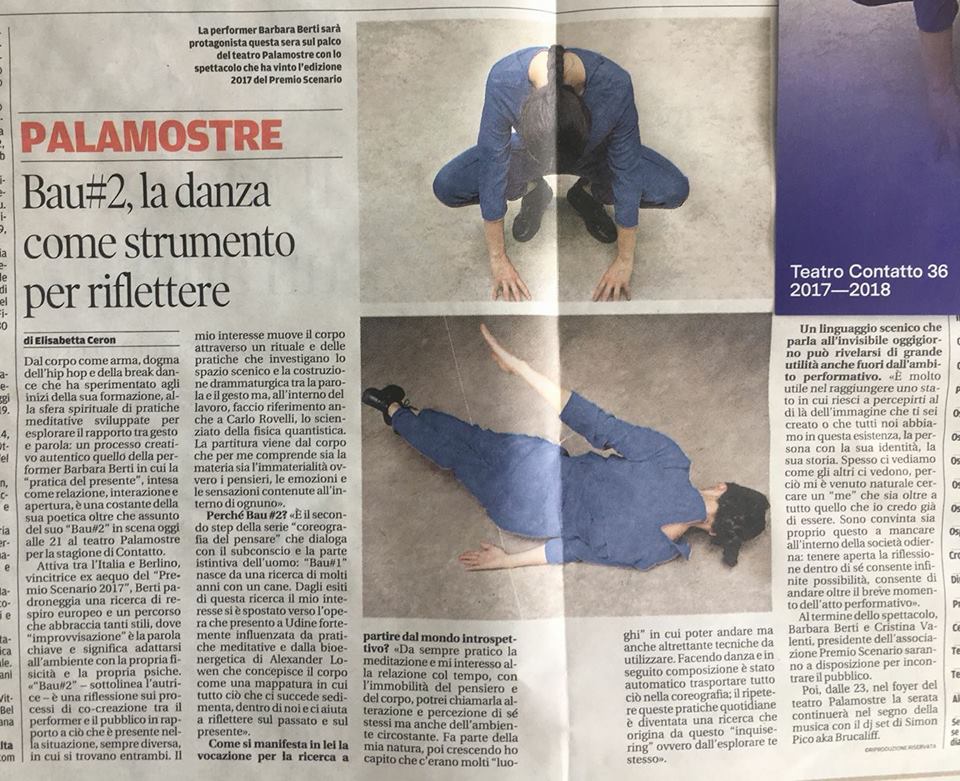
BAU#1 – An interactive piece
From the serie BAU – Choreography of thinking
Teatro Critica
Different, almost surprising, is the direction taken by Barbara Berti with her BAU #1, the first series of BAU ‘Choreography of thinking’ whose second outcome, BAU # 2, was the winner of the 2017 Scenario Award. Matching dance to acting a text to illustrate the possible relationships between language and gesture, as well as the connections between body reality and mental image, Berti enters here in the territory of the meta-choreography. The nostrils that quiver, or the teeth shown in a sneer, confer a desecrating imprint, which will eventually explode into canine onomatopoeia, barking. “Being here, feeling without feeling, listening without listening”: the monologue uttered by Berti deconstructs the choreographic work and its germinative process itself, using a seductive as well as enigmatic phrasing.
DOPPIO ZERO
At the arrival of the word, a thread of minute and collected voice, BAU # 1 changes in the animated caption of the “disembodiment”, in the choreographic dialogue with the spectators on separation and detachment between the action of thinking and the thought itself. Questions raise questions, measuring space with body and body with time. If in the Kinkaleri ‘All !’ project (presents in Contemporanea Festival with the rearrangement of their historical <OTTO>) the body sequences returned the letters of the alphabet, here the movement is the spelling of entire concepts, that are carried out in the expressions of legs, hands, arms, head
100GRADWORD – BAU1
“When energy shifts in a space”. For someone who has not studied dance, that sounds preposterous and esoteric. Barbara Berti impressively shows in “BAU # 1 – an interactive piece” what she means by that. We are in a room “full of intentions”, explains the Italian. As their bodies dance, their eyes talk to the audience. Her viewing slits narrow, Berti makes sure her viewers’ attention. Yes, available. So on: Berti yaps and barks, teeth flicking like a puppy. And the audience? Interacts and completes the beginning sentences of the dancer with what is heard and seen in space – unconsciously. (Agy)
CATALOGUE NATIONAL GALLERY OF ROME
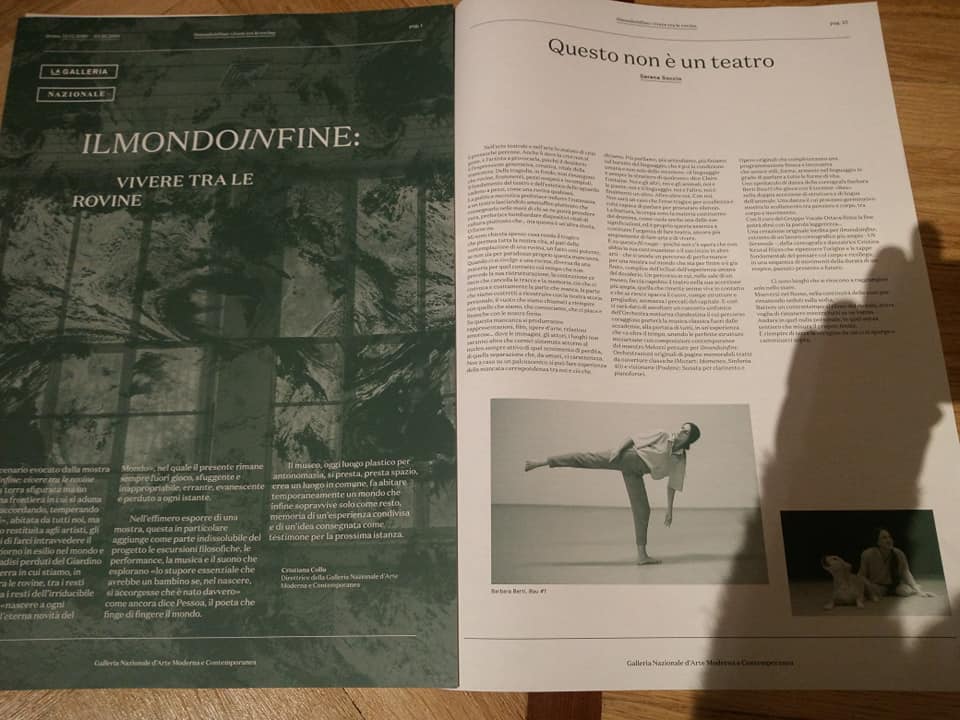
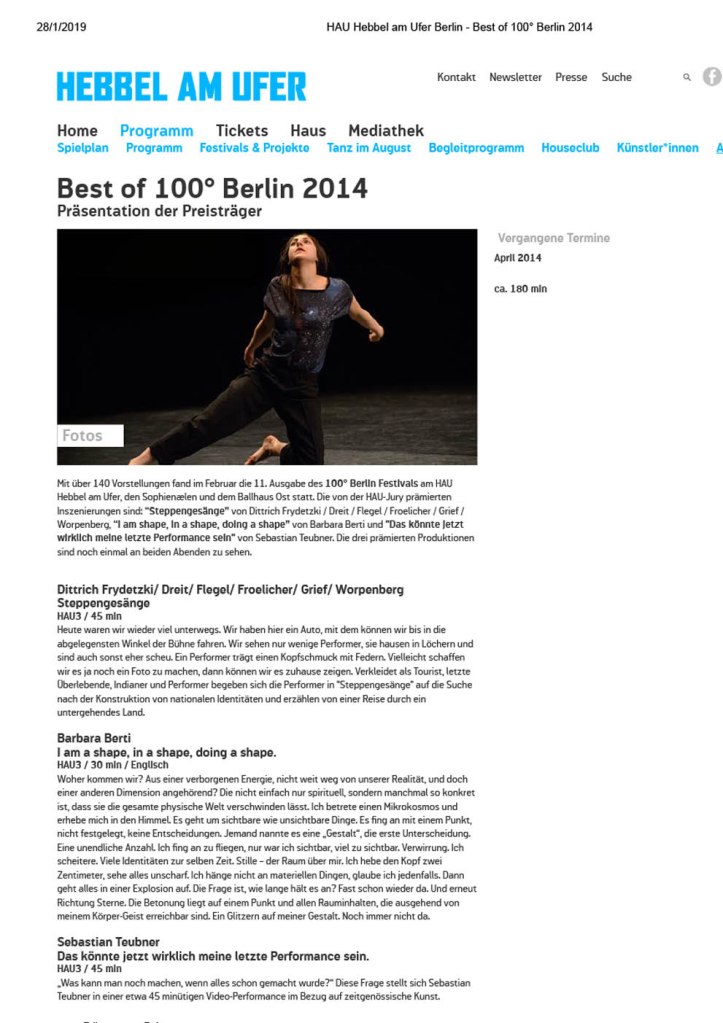
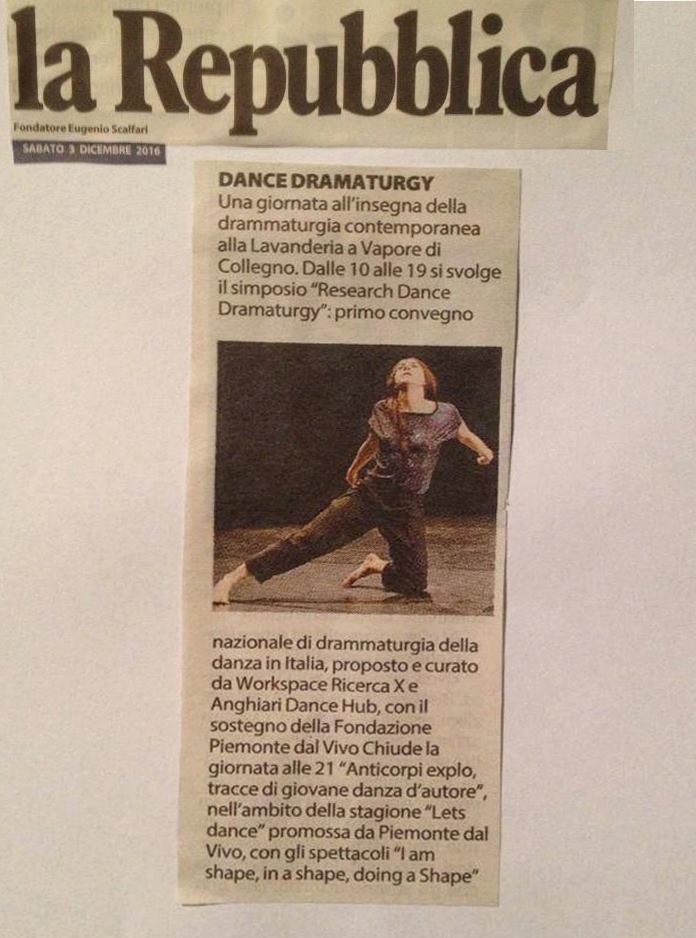
I am a shape, in a shape, doing a shape
Winner 100Grad Prize in 2014
JURY OF THE PRIZE
WITH EASY MEANS, “I AM SHAPE, IN A SHAPE, DOING A SHAPE” IS AN AMAZING AND INTELLIGENT PERFORMANCE THAT ATTACHES THE AUDIENCE AND REFLECTS IT AT THE SAME TIME. ON A MULTILAYER LEVEL THE PERFORMANCE SITUATION IS THEMED AND ARTISTICALLY FILIGRANE IMPLEMENTED. BARBARA BERTI CONVINCES PERFECTLY WITH ITS EXTRAORDINARY STAGE PRESENCE, AND SHOWS THAT HUMOR AND SERIOUSNESS CAN BE CLOSELY CLOSED TOGETHER. 1-2 TH APRIL 2014 HAU
MIT EINFACHEN MITTELN IST „I AM SHAPE, IN A SHAPE, DOING A SHAPE“ EINE UMWERFENDE UND INTELLIGENTE PERFORMANCE, DIE DAS PUBLIKUM FESSELT UND GLEICHZEITIG REFLEKTIERT. AUF VIELSCHICHTIGEN EBENEN WIRD DIE PERFORMANCESITUATION THEMATISIERT UND KÜNSTLERISCH FILIGRAN UMGESETZT. BARBARA BERTI ÜBERZEUGT VOLLKOMMEN MIT IHRER AUSSERORDENTLICHEN BÜHNENPRÄSENZ UND ZEIGT, DASS HUMOR UND ERNSTHAFTIGKEIT NAH BEIEINANDER LIEGEN KÖNNEN. 1-2 TH APRIL 2014 HAU
HTTPS://100GRAD.WORDPRESS.COM/2015/03/02/INTERAKTION-MIT-ALLEN-SINNE
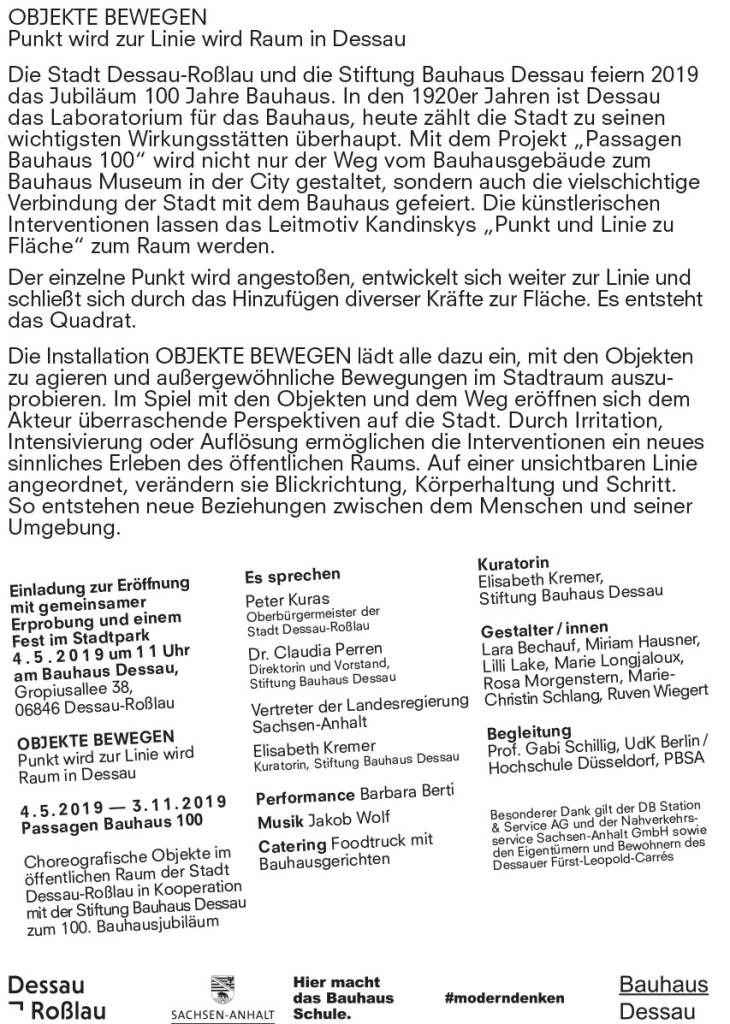
Passages Bauhaus – City of Dessau
Installations in the public domain.
at the Dessau Foundation Bauhaus
Video dance in tv HERE
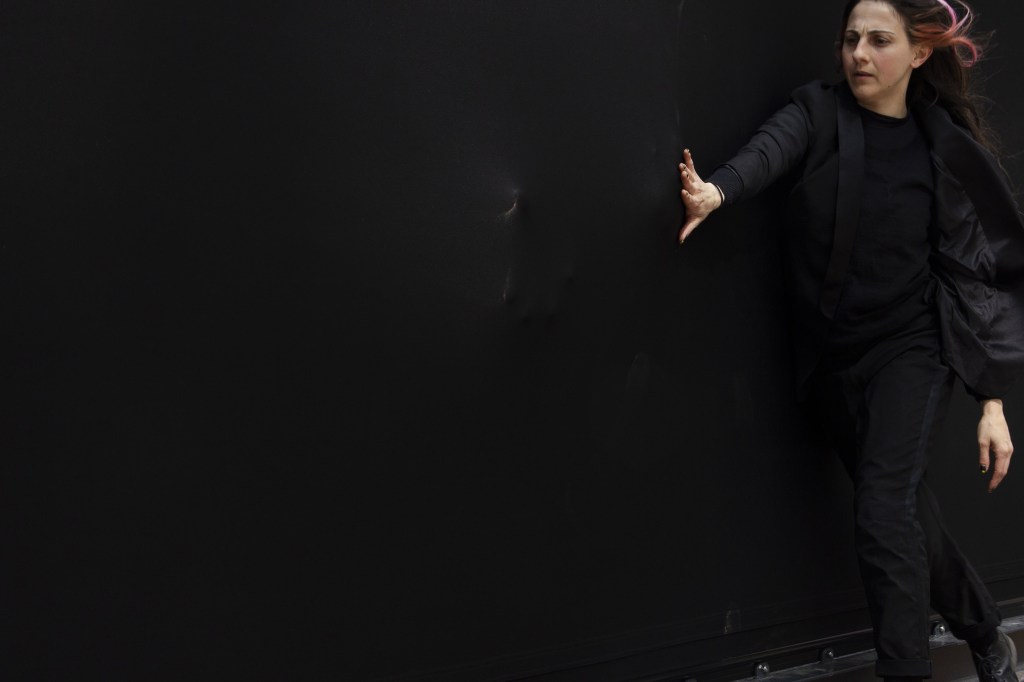
ACTING THINGS IV
The Choreography of Collaboration
Daniel Arsham and Judith Seng reveal the rich past, present and future of dance and design through a discussion of their collaborations with Merce Cunningham, Jonah Bokaer and Barbara Berti.
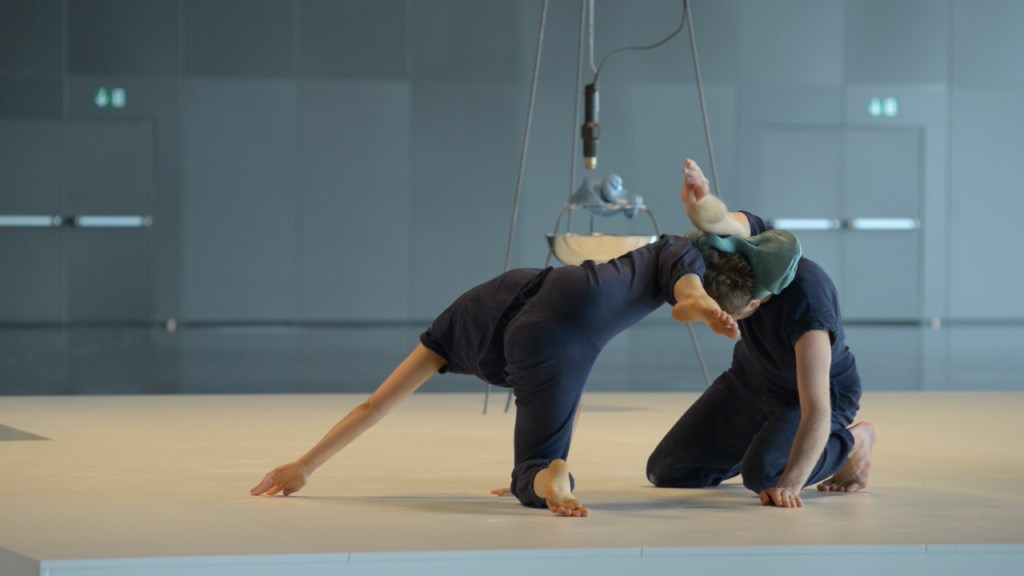
 BARBARA BERTI